Banks own neobanks
EUROPEAN FOCUS
Are neobanks the opposites of traditional banks, or their alter ego?
Are neobanks the opposites of traditional banks, or their alter ego?
This analysis covers only the most functional forms of neobanks: electronic money institutions (EMIs) licensed and regulated in the European Union. Lighter forms of neobanking, such as payment institutions (PIs), are outside the scope of this analysis. A separate study of neobanking-light will be published shortly.
Neobanks are no longer an exotic form of financial activity. Traditional banks are among the main beneficiaries of the opportunities provided by neobanking. Around 13.6% of neobanks in the EU are controlled by traditional banks. The synergy between traditional banks and neobanks is gradually becoming the Yin and Yang of financial infrastructure. Many banks create their own neobanks; others make active use of services provided by third-party neobanks.
The number of banks owning neobanks has increased by 21% over the past two years.
Neobanks are owned not only by large traditional banks, but also by medium-sized and smaller banks.
Banks and financial companies — including Pioneer, Nium, Airwallex and Alipay — collectively own at least 25% of the EU neobanking market.
Adding financial crypto companies — including Coinbase, Gemini, Kraken and Ripple, as well as privately held crypto companies — increases this share to 33.8%.
Financial companies own approximately the same number of neobanks as banks: 46 and 55 respectively.
Neobanks in the EU are also owned by non-EU banks, both officially and unofficially. At least 16 neobanks are confidentially controlled by non-EU banks (unofficial data).
If lighter forms of neobanking, such as Payment Institutions, are included, the number of “bank neobanks” increases by 270%. These neobanks often become part of a bank’s internal infrastructure.
If the analysis includes neobanks licensed in Switzerland, the United Kingdom, Canada, the United States, Singapore, Hong Kong, South Africa and other regions, banks and financial companies control up to 42% of the global market.
| No. | Typology | Number | Share, % |
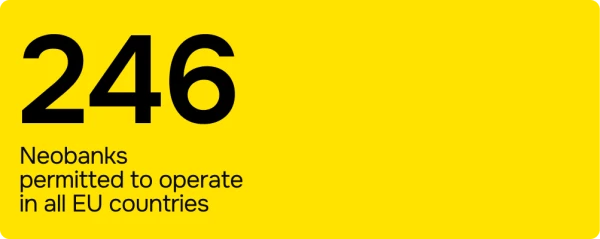
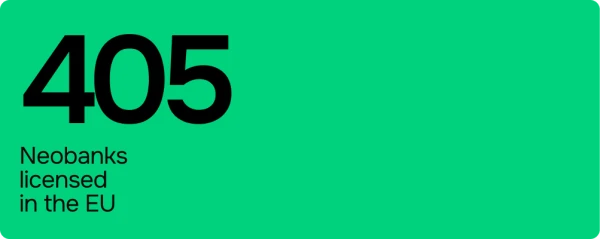
| 1 | Total number of EU neobanks (EMIs) | 405 | 100.00% |
| 2 | Officially linked to banks | 36 | 8.89% |
| 3 | Unofficially linked to banks | 19 | 4.69% |
| 4 | Officially linked to financial companies | 27 | 6.67% |
| 5 | Unofficially linked to financial companies | 19 | 4.69% |
| 6 | Officially linked to crypto companies | 12 | 2.96% |
| 7 | Unofficially linked to crypto companies | 24 | 5.93% |
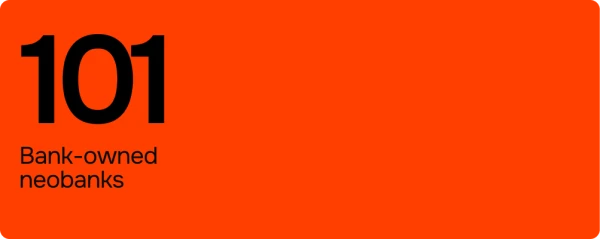
| 8 | Total controlled by banks and financial companies, excluding crypto companies | 101 | 24.94% |
| 9 | Total controlled by banks, crypto companies and financial companies | 137 | 33.83% |
The source article contains a detailed country-by-country table. Selected examples include:
| Licensing country | Neobank (EMI) | Banking group | Share / nature of control |
| France | Xpollens | BPCE | Control |
| Belgium | Buy Way | Santander | Control |
| Belgium | Fimaser | BNP Paribas | Joint control with Carrefour |
| Cyprus | JCC Payment Systems | Cypriot banks | Controlled by a group of local banks |
| Denmark | MobilePay | Danske Bank; Vipps | 72.2% held by the Vipps banking consortium (Norway) and 27.8% by Danske Bank |
| France | Treezor | Société Générale | Control since 2019. Mastercard is a minority co-owner |
| France | FORGE | Société Générale | Control |
| France | Okali | Crédit Agricole | Control |
| France | SFPMEI | Crédit Agricole | Control |
| France | Worldline | Several banks | Each bank holds less than 10% |
| France | Morning | Banque Edel | Control through Groupe E.Leclerc |
| France | Lyf | BNP Paribas; Crédit Mutuel Alliance | Joint control |
| Germany | VR Payment | DZ BANK Group | Control |
| Germany | Reisebank | DZ BANK | Control |
| Germany | PAYONE | Deutscher Sparkassenverlag / Sparkassen-Finanzgruppe | 40%; Worldline — 60% |
| Germany | Nexi Germany | CDP Equity | Approximately 19.1% of Nexi; stated intention to increase the stake to 29.9% |
| Germany | AllUnity | DWS (Deutsche Bank); Flow Traders; Galaxy | DWS (Deutsche Bank) has an economic interest of approximately 26.5% |
| Ireland | Square | Square Financial Services | SFS (a US bank) belongs to the same group as the US technology company Block |
| Italy | Mooney | Intesa Sanpaolo | Control — 50%. Enel holds the other 50% |
| Italy | Numia | Banco BPM; BCC Banca Iccrea | Each bank holds 28.57%. FSI (an investment fund) holds 42.86% |
| Italy | HYPE | Banca Sella | Control since 2026 |
| Italy | PostePay | BancoPosta | Control |
| Italy | LIS Pay | BancoPosta | Control |
| Italy | Nexi Payments Italy | CDP Equity | Approximately 19.1% of Nexi; stated intention to increase the stake to 29.9% |
| Italy | UnipolPay | BPER Banca | The Unipol group controls BPER and UnipolPay |
| Italy | Flowe | Banca Mediolanum | Acquired in 2026 by DINIT (Cornèr Bank Group, Switzerland) |
| Latvia | Dukascopy Payments | Dukascopy Bank | Control |
| Lithuania | Contis | Solaris | Control |
| Lithuania | Revolut Payments | Revolut Bank | The neobank and bank have belonged to the same group since 2022 |
| Luxembourg | J.P. Morgan Mobility Payments Solutions | JPMorgan Chase | Control. Volkswagen holds approximately 25% |
| Luxembourg | CPS Europe | Cornèr Bank Group | Control |
| Luxembourg | CPS Europe S.A. | Cornèr Bank Group | Control |
| Luxembourg | Mercedes Pay | Mercedes-Benz Bank | The neobank and bank are controlled by the automotive group |
| Luxembourg | Standard Chartered Luxembourg | Standard Chartered | Control |
| Spain | Getnet eMoney | Banco Santander | Santander controls the company through Getnet |
| Spain | Global Payments MoneyToPay | CaixaBank | 49% ownership. Control is held by Global Payments |
Data cut-off: 1 August 2026.
We'll send details to the email you provided soon.
You can unsubscribe at any time by following the link in the email.